
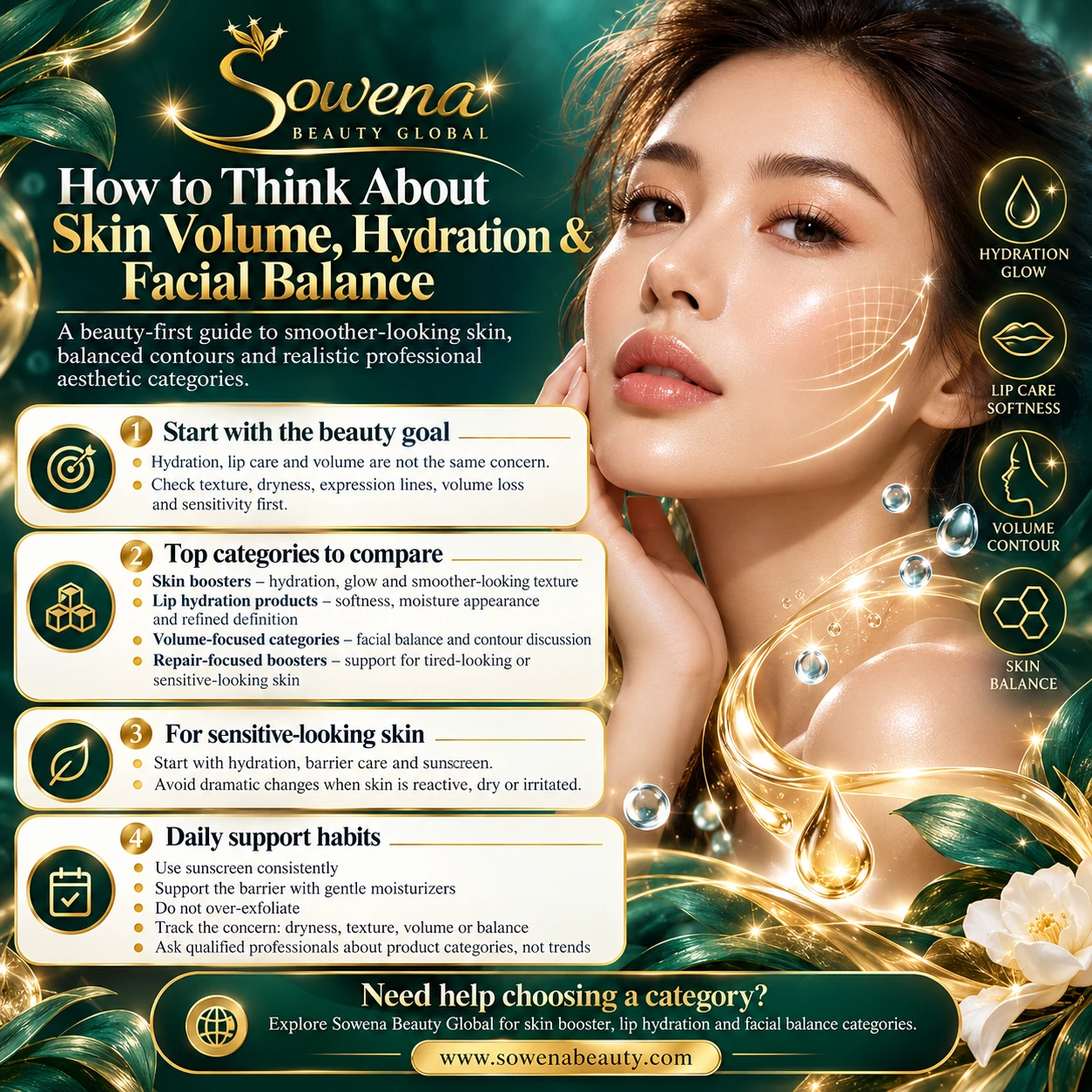
Skin volume and hydration affect how fresh, rested and balanced the face appears. When cheeks look flat, lips look dry or fine lines sit more visibly on the surface, many people start comparing professional aesthetic categories. The best starting point is not "more volume"; it is understanding which concern you actually want to improve.
Start with the beauty goal
A hydrated skin booster, a lip hydration product and a volume-focused category are not the same thing. If the skin mainly looks dull or dehydrated, hydration and barrier support may matter more than contour change. If the concern is facial balance, a professional consultation can help separate volume, texture and proportion.
Good beauty planning begins with a mirror check: texture, dryness, asymmetry, expression lines, volume loss and sensitivity all need different approaches.
Top categories to compare before choosing
Readers often compare multiple categories before deciding what makes sense for their skin goals. These broad groups are useful starting points.
- Skin boosters: hydration, glow and smoother-looking texture.
- Lip hydration products: softness, moisture appearance and refined definition.
- Volume-focused categories: facial balance and contour discussion with a professional.
- Repair-focused boosters: tired-looking or sensitive-looking skin support.
What works well for sensitive-looking skin
Sensitive-looking skin usually benefits from restraint. Start with hydration, barrier care and sunscreen before considering stronger professional categories. Avoid chasing dramatic changes if the skin is currently reactive, dry or irritated.
For many people, the best first step is a product category that supports moisture and comfort. Once the skin looks calmer, a qualified professional can better assess whether volume, texture or contour is the real priority.
Daily methods that support better-looking results
Professional products do not replace daily habits. Skin often looks better when the basics are steady.
- Use sunscreen consistently to reduce photoaging triggers.
- Support the barrier with gentle moisturizers.
- Do not over-exfoliate before considering professional care.
- Track the concern: dryness, texture, volume or facial balance.
- Ask qualified professionals about product categories, not trends.
Useful next steps
Review the Sowena product catalogue to compare skin booster, lip hydration and aesthetic categories. You can also follow Sowena on Instagram, join the Telegram community, or message the team on WhatsApp.
FAQ
Should I choose hydration or volume first?
If skin looks dry, dull or sensitive, hydration and barrier support are often the better first conversation. Volume-focused categories should be discussed with a qualified professional.
What categories are good for sensitive-looking skin?
Gentle hydration boosters, repair-focused boosters and barrier care are usually more sensible starting points than aggressive routines.
Who is this guide for?
This guide is for readers comparing skin hydration, volume and facial balance categories before choosing a beauty plan.
How to use this guide
The title “How to think about skin volume, hydration and facial balance” sets a specific reader expectation: the page should explain what How to think about skin volume, hydration and facial balance is, place it in the skin volume category and help a buyer distinguish verified product information from broad promotional language. A useful reading begins with the exact item in front of you. Confirm the name, presentation, manufacturer or brand owner, country-specific label and the documents supplied with that unit. Similar names, refreshed boxes and regional versions can exist, so a photograph or reseller caption is not enough to establish identity. This page therefore treats the title as a research question rather than a promise. It connects the product name with practical beauty goals while keeping formulation, suitability and regulatory conclusions tied to current evidence.
For this article, the catalogue context identifies the subject as How to think about skin volume, hydration and facial balance, associated with How to think about skin volume, hydration and facial balance and the skin volume category. Those catalogue fields help organise the discussion, but they are not a substitute for the current label. Before relying on any claim, compare the physical package with the latest technical information and an official manufacturer or authorised regional source when one is available. Check spelling, lot information, expiry marking, storage statement, seals and presentation details. If one element conflicts with the documentation, pause the decision and ask for clarification. This verification-first step is relevant whether the reader is comparing a familiar product, a new packaging version or several products with similar marketing terms.
Product purpose, area and realistic appearance goals
The most relevant application context for this topic is the skin area named on the current label and assessed for the reader's specific concern. That phrase is intentionally cautious because the exact area must match the current product documentation, local rules and an individual assessment. A category name cannot establish that every product in the group is suitable for every facial or body zone. Readers should separate broad goals such as hydration, smoother-looking texture, balanced contours or a refreshed appearance from product-specific indications. The useful question is not simply “Is How to think about skin volume, hydration and facial balance popular?” but “Does the documented purpose of this exact product match the visible concern, the area being considered and the level of professional oversight required?” This keeps the article connected to the title without turning general education into personal treatment advice.
Appearance goals also need a consistent observation method. Compare photographs taken in similar lighting, from the same angle and at a similar time of day. Note surface comfort, hydration, reflection, texture and the way makeup sits rather than relying on one dramatic image. Facial expression, camera distance, sleep, hydration and editing can change how skin or contours look. A responsible How to think about skin volume, hydration and facial balance review therefore describes modest, observable goals and acknowledges variation. It should never guarantee an outcome, imply that one product can correct every concern or present a before-and-after photograph as proof that the same change will occur for another person.
Ingredients and finished-formulation evidence
Ingredient names are useful only when they are connected to the finished product. A broad study about hyaluronic acid, polynucleotides, amino acids, peptides, collagen-related materials or another fashionable ingredient may explain a scientific concept, but it does not automatically prove the performance of How to think about skin volume, hydration and facial balance. Concentration, molecular characteristics, excipients, manufacturing, presentation and the intended category can change how a formulation should be interpreted. Ask whether the evidence describes the same finished product, the same area and a comparable population. When an ingredient or concentration cannot be verified from current documentation, the correct editorial choice is to state that gap rather than infer a specification from the product name.
Readers can use an evidence hierarchy. Start with the current product label and instructions, then look for official technical documents and relevant regulatory information. Product-specific human research is more informative than a study on a loosely related ingredient. Independent reviews and authoritative clinical guidance can help explain limitations, while social posts and sales captions are better treated as leads to verify, not final proof. This hierarchy makes the article more useful for How to think about skin volume, hydration and facial balance: it rewards specific documentation, exposes uncertainty and reduces the risk of repeating a claim simply because it appears on many reseller pages.
How the three images support the article
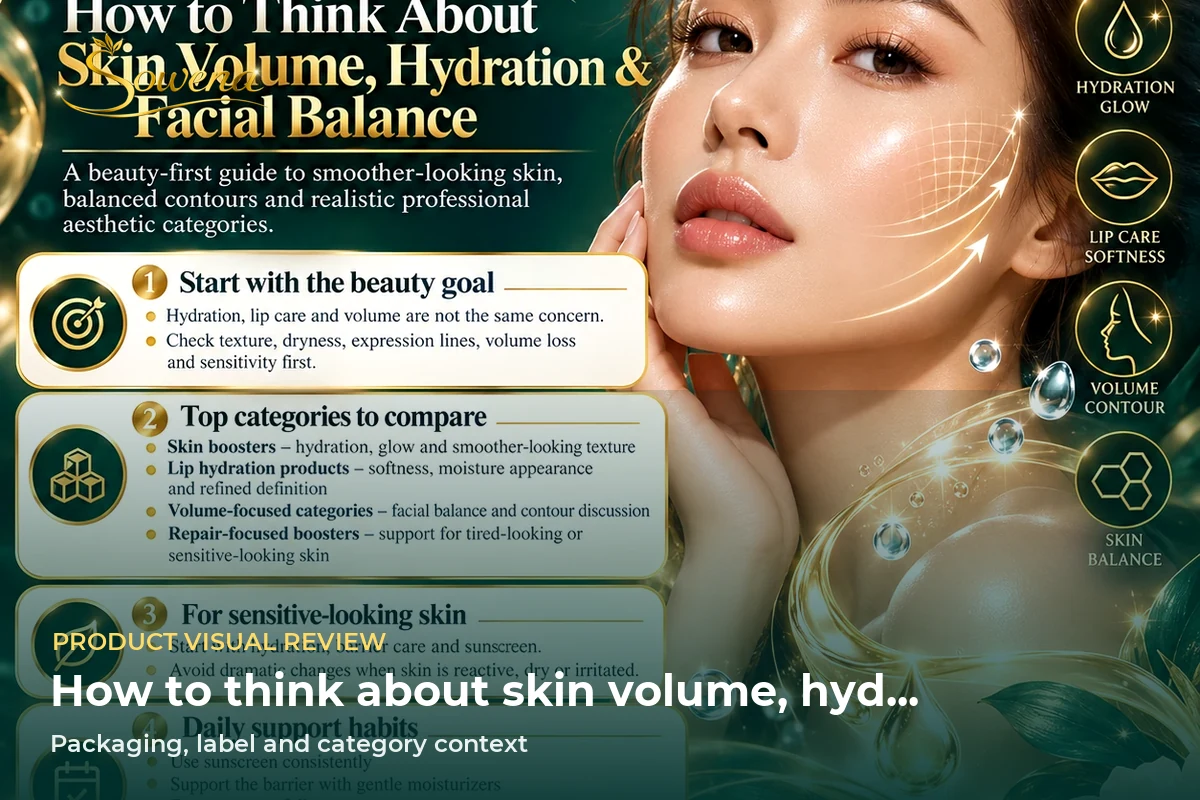
The first image identifies the article and its product or category context. The second image is a closer visual review derived from the approved Sowena source image, allowing readers to inspect presentation details without introducing an unrelated distributor watermark. The third image connects the topic with the skin area named on the current label and assessed for the reader's specific concern. These images are educational aids, not authentication certificates. Packaging can change, generated editorial elements are not product evidence, and a photograph cannot confirm storage history or contents. Use the images to understand the article structure, then verify the physical unit and documentation independently.
Authenticity, storage and condition checks
A product can look correct in a photograph and still require further verification. Review seals, batch and expiry information, storage instructions, package condition and the consistency of the inner and outer presentation. Ask how the item was stored and transported when temperature or handling could affect quality. Keep invoices and product photographs linked to the same unit. If the package is damaged, information is missing, or the seller cannot explain the supply chain, do not treat a low price or familiar box design as reassurance. These checks are particularly important for professional-use products because appearance alone cannot establish sterility, authenticity or appropriate handling.
Country context matters as well. A product available in one market may have different status, labelling or professional restrictions in another. The catalogue origin listed for How to think about skin volume, hydration and facial balance can help a reader locate the relevant manufacturer information, but it does not establish approval everywhere. Check the regulator and professional rules that apply where the product would actually be used. Avoid unsupported phrases such as “globally approved” unless a current source defines the jurisdictions involved. Clear geographic language is more accurate and more useful for readers than a sweeping regulatory claim.
Routine support and sensitive-skin considerations
A stable daily routine creates a better baseline for evaluating beauty goals related to How to think about skin volume, hydration and facial balance. Gentle cleansing, a suitable moisturiser and consistent broad-spectrum sun protection support comfort and make visible changes easier to interpret. Introducing several strong topical actives at once can create dryness or redness that obscures the original concern. Readers with reactive skin should document fragrances, adhesives, topical anaesthetics, active ingredients and previous reactions. Patch testing may help with suitable topical cosmetics, but it does not determine whether a professional-use product or procedure is appropriate.
Persistent redness, pain, swelling, rash, infection, rapidly changing pigmentation or another concerning symptom needs qualified healthcare advice rather than product experimentation. A beauty article cannot diagnose the cause of a symptom. The useful role of this guide is to help readers prepare better questions: what concern is being assessed, what does the current label support, what alternatives exist, what would make a professional advise waiting, and how will progress or an adverse reaction be documented? This keeps the discussion reader-first and avoids presenting How to think about skin volume, hydration and facial balance as a universal solution.
Comparing How to think about skin volume, hydration and facial balance with related options
Compare products by purpose before comparing price. Two items may sit in the same skin volume category yet differ in presentation, verified composition, intended area, evidence and professional requirements. Create a short table with the exact product name, documented purpose, key verified ingredients, area, evidence type, storage needs and unresolved questions. Leave a field blank when information is unavailable. An honest blank is more valuable than an assumption. This method also prevents a common search mistake: choosing the product with the longest ingredient list or the strongest marketing adjective without checking whether it matches the reader's goal.
Alternatives should include simpler options. If the main concern is temporary dryness or barrier discomfort, a consistent topical routine may deserve attention before a professional product. If the concern is structural volume, pigmentation, active acne, scarring or another distinct issue, it may belong to a different product category or assessment. The title of this article remains useful when it helps the reader identify those boundaries. Good SEO content does not force every search toward the featured item; it gives enough context to recognise when How to think about skin volume, hydration and facial balance may not be the right comparison.
Questions for a qualified consultation
Bring the exact product name and clear photographs of the package to a consultation. Ask the professional to explain the product category, documented purpose, relevant area, expected limits, alternatives, reasons to postpone and the plan for recording concerns. Share allergies, medicines, previous procedures, pregnancy or breastfeeding status when relevant, active skin conditions and any history of unusual reactions. Do not request dosage or technique from a marketing article. Those decisions require training, current product information, local scope-of-practice rules and an individual assessment.
A strong final decision is easy to explain in one sentence: the documented purpose of this exact product matches the concern and area, the source and condition have been checked, the limitations are understood, and an appropriately qualified local professional has assessed suitability. If that sentence cannot yet be supported, the next step is more verification rather than a faster purchase. This standard applies to How to think about skin volume, hydration and facial balance and to every related product presented on Sowena.
Related Sowena reading
- Aqua PN: product facts, realistic goals and professional consultationRelated skin volume reading on Sowena.
- Aqualyx: product facts, realistic goals and professional consultationRelated skin volume reading on Sowena.
- Body contouring products: evidence, claims and evidence and safety checksRelated skin volume reading on Sowena.