
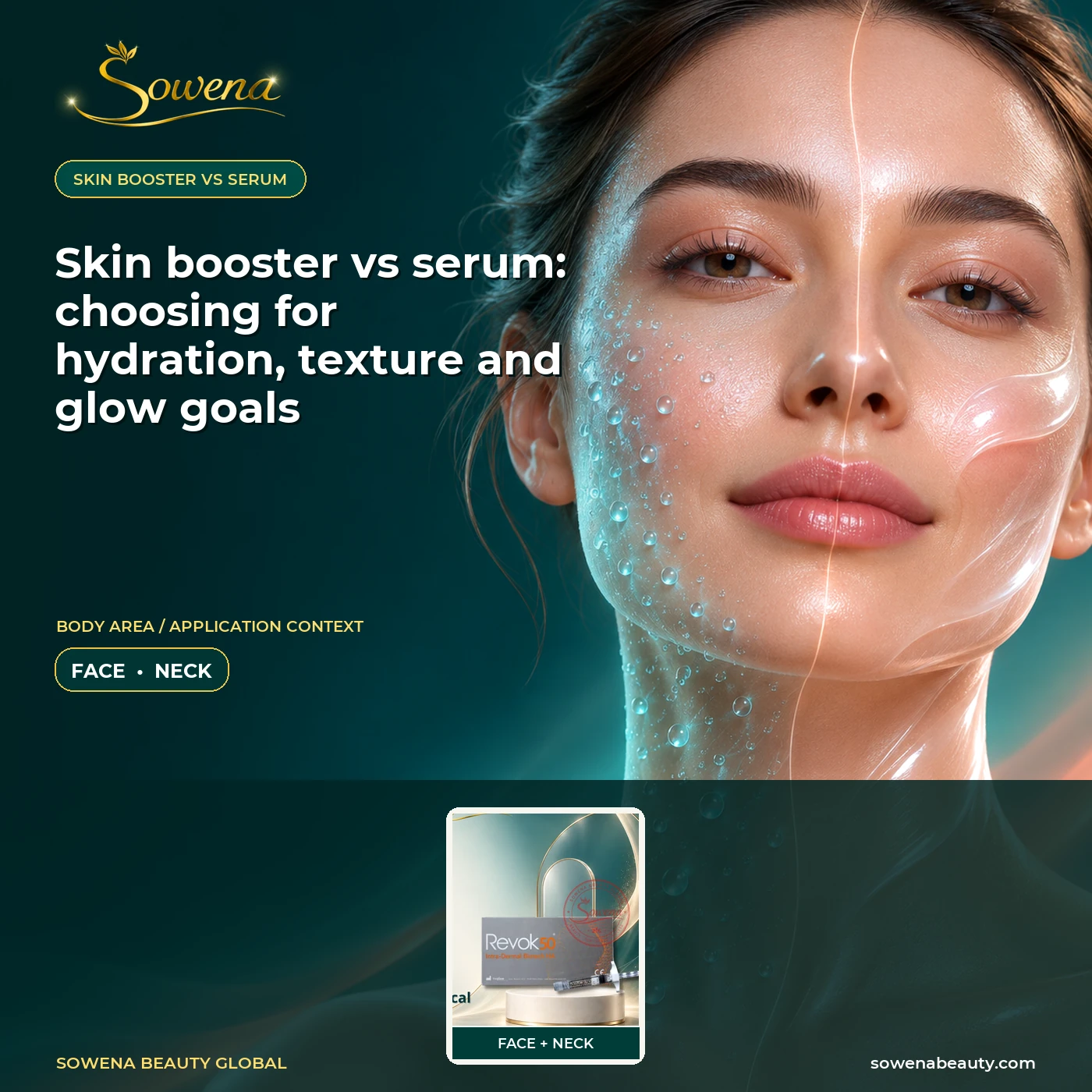
Skin booster vs serum: choosing for hydration, texture and glow goals is easier to understand when marketing language is translated into a decision process. The central topic is skin boosters and topical serums. In practice, the two categories differ in route, oversight, evidence and risk. Readers get more value from asking what is verified, what is merely plausible, and what requires an individual consultation.
This guide is educational. It does not diagnose a condition, recommend a procedure, provide injection technique or promise an outcome. Product availability and permitted uses vary by country, and professional products require appropriately qualified local care.
Begin with the concern, not the category name
Write down the visible or sensory concern in plain language: dryness, rough-looking texture, uneven tone, loss of volume, expression-related lines, eye-area shadowing or general sensitivity. Then ask whether the concern is stable, whether it changes with the season, and whether a basic routine has already been made consistent.
This step prevents category shopping. A person with barrier damage may need simpler cleansing and moisturising care, while a structural concern needs a different conversation. When the goal is vague, almost any product can appear relevant. When the goal is precise, unsuitable options become easier to exclude.
A three-level evidence check
First, biological plausibility asks whether an ingredient or material could reasonably influence the target pathway. Second, category evidence looks at studies across related formulations. Third, finished-product evidence asks whether the exact item, in a comparable population and intended use, has been evaluated. These levels should not be merged.
For skin boosters and topical serums, a responsible conclusion is often conditional rather than dramatic. Evidence may support further consideration while still leaving questions about formulation, concentration, technique, follow-up or long-term outcomes. Marketing often removes those conditions; careful reading restores them.
How to compare options fairly
The practical method is to start with the concern and choose the least complex suitable category. Put each option in a simple table with the verified composition, intended category, professional requirements, evidence type, realistic appearance goal, limitations and source of documentation. Leave a field blank when the answer is unknown instead of filling it with an assumption.
Compare like with like. A topical cosmetic should not be judged by the same route or risk profile as a professional-use product. A hydrating skin-quality category should not be treated as a substitute for structural volume correction. Similar words on the front of a package do not create equivalence.
What realistic beauty goals look like
Useful goals are visible, gradual and measurable without filters. They may include more comfortable-feeling skin, less obvious surface dryness, smoother light reflection, a more even-looking texture or a rested appearance. Goals such as permanent pore removal, guaranteed rejuvenation or reversing normal ageing are not realistic product standards.
Take photographs in the same light, position and camera settings. Record routine changes and timing. This protects against selective memory and helps separate temporary hydration from a sustained change. It also gives a practitioner better information if the plan needs to be adjusted.
Daily skincare still sets the baseline
A short routine can reveal more than a crowded one. Use a gentle cleanser, a moisturiser that matches current dryness and climate, and broad-spectrum sunscreen. Add one active at a time only when the skin is comfortable. This approach is especially useful before evaluating a new professional category.
Retinoids, vitamin C, exfoliating acids and pigment-focused ingredients can be valuable for suitable users, but combining them aggressively may increase redness and sensitivity. Consistency and tolerability usually contribute more to a healthy-looking surface than frequent switching.
Sensitive-skin considerations
Sensitive skin can describe stinging, flushing, allergy, dermatitis, dryness or temporary barrier disruption. A product advertised as gentle is not automatically suitable for every cause. Keep a record of triggers, previous reactions, allergies, medicines and recent procedures, and share it during a qualified consultation.
Patch testing can help with suitable topical cosmetics but cannot establish suitability for a professional-use product. Persistent burning, facial swelling, widespread rash, infection signs or rapidly changing pigmentation should lead to healthcare advice rather than another beauty purchase.
Documentation matters
For any professional product, request the current label, manufacturer identification, batch and expiry details, storage requirements and relevant local documentation. Check that information is consistent across the box, immediate container and supporting records. A social-media photo is not a substitute for traceability.
Packaging can change and counterfeits can copy visual details. Verification should therefore combine physical inspection with supplier records and, when possible, confirmation from an official manufacturer or authorised regional channel.
Questions for a useful consultation
- What exact concern are we trying to improve, and what would count as a realistic change?
- Which category is being proposed, and why is it more suitable than simpler alternatives?
- What evidence applies to the exact finished product?
- What are the limitations, temporary effects and important warning signs?
- How are authenticity, storage and local regulatory requirements checked?
- What follow-up is available if the result or recovery differs from expectations?
Common comparison mistakes
Do not rank products only by ingredient count, concentration printed in large type, country-of-origin stereotypes, influencer popularity or price. None of these alone establishes suitability. Do not assume that a familiar ingredient makes every route of use equally low risk. And do not interpret the absence of immediate discomfort as proof of long-term benefit.
A balanced comparison includes reasons not to choose an option. It recognises when home care may be enough, when a consultation should be postponed, and when a concern sits outside cosmetic care. This is a sign of good decision making, not a lack of enthusiasm.
Building a one-page decision sheet
Create sections for the concern, baseline routine, verified product facts, evidence, alternatives, questions, cost, follow-up and stop conditions. Keep source links beside each claim. A one-page sheet makes it easier to compare several options without losing the distinction between facts and promotional language.
Update the sheet when packaging or documentation changes. If a key fact cannot be verified, mark it as unknown. That small habit can prevent a confident-looking but poorly supported purchase.
How to review online claims critically
Start by identifying who published the claim and what they are selling. Look for the exact product name, a publication date, a clear study design and a population that resembles the intended user. A scientific reference is useful only when the linked paper actually supports the sentence beside it. Research on an isolated ingredient, cells or animals should not be presented as proof of a predictable cosmetic result in people.
Before-and-after images need the same lighting, distance, facial expression and camera settings. Makeup, dehydration, recent skincare and image processing can change appearance dramatically. Treat testimonials as personal experiences rather than controlled evidence. If a page avoids limitations, adverse effects or alternative explanations, use it as a prompt for questions rather than a final answer.
Review the decision over time
A good plan includes a review point. Record the starting concern, the agreed goal and the routine being used, then reassess with comparable observations. More is not automatically better when progress is slow. Adding several products or procedures at once makes it harder to identify what helped, what irritated the skin and what created no value.
Keep expectations flexible. Skin changes with climate, hormones, stress, sleep, illness and sun exposure. A category that sounded suitable during initial research may become unnecessary after the barrier improves, or inappropriate after a qualified examination. The ability to pause is part of a responsible beauty plan.
Related Sowena guides
Continue with Sensitive-skin checklist before choosing a professional aesthetic product VS Collagen NAD+: product facts, realistic goals and professional consultation What is NAD+ in professional aesthetic product conversations? VS Multi-lamellar NAD+: product facts, realistic goals and professional consultation. Browse the product catalogue, learn about Sowena Beauty Global, or use the contact page for general guidance.
Authoritative context
The following independent source provides context for the category or its safety boundaries. It does not endorse a particular product and should be read alongside local professional guidance.
Connect with Sowena
- InstagramBeauty education and approved visuals.
- WhatsApp guidanceAsk in English about the topic and related categories.
- Telegram communityFollow community updates.
Frequently asked questions
What is the best first step when comparing skin boosters and topical serums?
Define the concern and stabilise basic skincare before comparing verified composition, evidence, intended category and professional requirements.
Does a popular ingredient guarantee a better result?
No. The finished formulation, intended use, evidence, skin context and qualified care all matter. Ingredient popularity is not a guarantee.
When should cosmetic research stop and medical advice begin?
Seek healthcare advice for persistent or severe symptoms, infection signs, rapidly changing pigmentation, significant swelling or concerns that may represent a medical condition.
How to use this guide
The title “Skin booster vs serum: choosing for hydration, texture and glow goals” sets a specific reader expectation: the page should explain what Skin booster vs serum is, place it in the consumer skin booster decisions category and help a buyer distinguish verified product information from broad promotional language. A useful reading begins with the exact item in front of you. Confirm the name, presentation, manufacturer or brand owner, country-specific label and the documents supplied with that unit. Similar names, refreshed boxes and regional versions can exist, so a photograph or reseller caption is not enough to establish identity. This page therefore treats the title as a research question rather than a promise. It connects the product name with practical beauty goals while keeping formulation, suitability and regulatory conclusions tied to current evidence.
For this article, the catalogue context identifies the subject as Skin booster vs serum, associated with Skin booster vs serum and the consumer skin booster decisions category. Those catalogue fields help organise the discussion, but they are not a substitute for the current label. Before relying on any claim, compare the physical package with the latest technical information and an official manufacturer or authorised regional source when one is available. Check spelling, lot information, expiry marking, storage statement, seals and presentation details. If one element conflicts with the documentation, pause the decision and ask for clarification. This verification-first step is relevant whether the reader is comparing a familiar product, a new packaging version or several products with similar marketing terms.
Product purpose, area and realistic appearance goals
The most relevant application context for this topic is facial skin and any additional area explicitly supported by the exact product documentation. That phrase is intentionally cautious because the exact area must match the current product documentation, local rules and an individual assessment. A category name cannot establish that every product in the group is suitable for every facial or body zone. Readers should separate broad goals such as hydration, smoother-looking texture, balanced contours or a refreshed appearance from product-specific indications. The useful question is not simply “Is Skin booster vs serum popular?” but “Does the documented purpose of this exact product match the visible concern, the area being considered and the level of professional oversight required?” This keeps the article connected to the title without turning general education into personal treatment advice.
Appearance goals also need a consistent observation method. Compare photographs taken in similar lighting, from the same angle and at a similar time of day. Note surface comfort, hydration, reflection, texture and the way makeup sits rather than relying on one dramatic image. Facial expression, camera distance, sleep, hydration and editing can change how skin or contours look. A responsible Skin booster vs serum review therefore describes modest, observable goals and acknowledges variation. It should never guarantee an outcome, imply that one product can correct every concern or present a before-and-after photograph as proof that the same change will occur for another person.
Ingredients and finished-formulation evidence
Ingredient names are useful only when they are connected to the finished product. A broad study about hyaluronic acid, polynucleotides, amino acids, peptides, collagen-related materials or another fashionable ingredient may explain a scientific concept, but it does not automatically prove the performance of Skin booster vs serum. Concentration, molecular characteristics, excipients, manufacturing, presentation and the intended category can change how a formulation should be interpreted. Ask whether the evidence describes the same finished product, the same area and a comparable population. When an ingredient or concentration cannot be verified from current documentation, the correct editorial choice is to state that gap rather than infer a specification from the product name.
Readers can use an evidence hierarchy. Start with the current product label and instructions, then look for official technical documents and relevant regulatory information. Product-specific human research is more informative than a study on a loosely related ingredient. Independent reviews and authoritative clinical guidance can help explain limitations, while social posts and sales captions are better treated as leads to verify, not final proof. This hierarchy makes the article more useful for Skin booster vs serum: it rewards specific documentation, exposes uncertainty and reduces the risk of repeating a claim simply because it appears on many reseller pages.
How the three images support the article
The first image identifies the article and its product or category context. The second image is a closer visual review derived from the approved Sowena source image, allowing readers to inspect presentation details without introducing an unrelated distributor watermark. The third image connects the topic with facial skin and any additional area explicitly supported by the exact product documentation. These images are educational aids, not authentication certificates. Packaging can change, generated editorial elements are not product evidence, and a photograph cannot confirm storage history or contents. Use the images to understand the article structure, then verify the physical unit and documentation independently.
Authenticity, storage and condition checks
A product can look correct in a photograph and still require further verification. Review seals, batch and expiry information, storage instructions, package condition and the consistency of the inner and outer presentation. Ask how the item was stored and transported when temperature or handling could affect quality. Keep invoices and product photographs linked to the same unit. If the package is damaged, information is missing, or the seller cannot explain the supply chain, do not treat a low price or familiar box design as reassurance. These checks are particularly important for professional-use products because appearance alone cannot establish sterility, authenticity or appropriate handling.
Country context matters as well. A product available in one market may have different status, labelling or professional restrictions in another. The catalogue origin listed for Skin booster vs serum can help a reader locate the relevant manufacturer information, but it does not establish approval everywhere. Check the regulator and professional rules that apply where the product would actually be used. Avoid unsupported phrases such as “globally approved” unless a current source defines the jurisdictions involved. Clear geographic language is more accurate and more useful for readers than a sweeping regulatory claim.
Routine support and sensitive-skin considerations
A stable daily routine creates a better baseline for evaluating beauty goals related to Skin booster vs serum. Gentle cleansing, a suitable moisturiser and consistent broad-spectrum sun protection support comfort and make visible changes easier to interpret. Introducing several strong topical actives at once can create dryness or redness that obscures the original concern. Readers with reactive skin should document fragrances, adhesives, topical anaesthetics, active ingredients and previous reactions. Patch testing may help with suitable topical cosmetics, but it does not determine whether a professional-use product or procedure is appropriate.
Persistent redness, pain, swelling, rash, infection, rapidly changing pigmentation or another concerning symptom needs qualified healthcare advice rather than product experimentation. A beauty article cannot diagnose the cause of a symptom. The useful role of this guide is to help readers prepare better questions: what concern is being assessed, what does the current label support, what alternatives exist, what would make a professional advise waiting, and how will progress or an adverse reaction be documented? This keeps the discussion reader-first and avoids presenting Skin booster vs serum as a universal solution.
Comparing Skin booster vs serum with related options
Compare products by purpose before comparing price. Two items may sit in the same consumer skin booster decisions category yet differ in presentation, verified composition, intended area, evidence and professional requirements. Create a short table with the exact product name, documented purpose, key verified ingredients, area, evidence type, storage needs and unresolved questions. Leave a field blank when information is unavailable. An honest blank is more valuable than an assumption. This method also prevents a common search mistake: choosing the product with the longest ingredient list or the strongest marketing adjective without checking whether it matches the reader's goal.
Alternatives should include simpler options. If the main concern is temporary dryness or barrier discomfort, a consistent topical routine may deserve attention before a professional product. If the concern is structural volume, pigmentation, active acne, scarring or another distinct issue, it may belong to a different product category or assessment. The title of this article remains useful when it helps the reader identify those boundaries. Good SEO content does not force every search toward the featured item; it gives enough context to recognise when Skin booster vs serum may not be the right comparison.
Questions for a qualified consultation
Bring the exact product name and clear photographs of the package to a consultation. Ask the professional to explain the product category, documented purpose, relevant area, expected limits, alternatives, reasons to postpone and the plan for recording concerns. Share allergies, medicines, previous procedures, pregnancy or breastfeeding status when relevant, active skin conditions and any history of unusual reactions. Do not request dosage or technique from a marketing article. Those decisions require training, current product information, local scope-of-practice rules and an individual assessment.
A strong final decision is easy to explain in one sentence: the documented purpose of this exact product matches the concern and area, the source and condition have been checked, the limitations are understood, and an appropriately qualified local professional has assessed suitability. If that sentence cannot yet be supported, the next step is more verification rather than a faster purchase. This standard applies to Skin booster vs serum and to every related product presented on Sowena.
Related Sowena reading
- Sensitive-skin checklist before choosing a professional aesthetic productRelated consumer skin booster decisions reading on Sowena.
- Aqua PN: product facts, realistic goals and professional consultationRelated consumer skin booster decisions reading on Sowena.
- Aqualyx: product facts, realistic goals and professional consultationRelated consumer skin booster decisions reading on Sowena.