
VS NAD+ sits within a fast-growing professional skin-booster category that uses the language of cellular energy, revitalisation and visible skin quality. Those themes attract interest, but they also make careful product evaluation essential. A clinic, distributor or international beauty partner should separate three different things: what the package states, what the brand officially confirms and what scientific research says about NAD+ biology in general.
This guide does that separation. It is designed to help professional buyers prepare better questions before requesting a quotation. It does not provide treatment instructions, dosing advice or a promise of clinical outcomes. Product eligibility, permitted use and professional scope vary by market and should be checked locally.
VS NAD+ at a glance
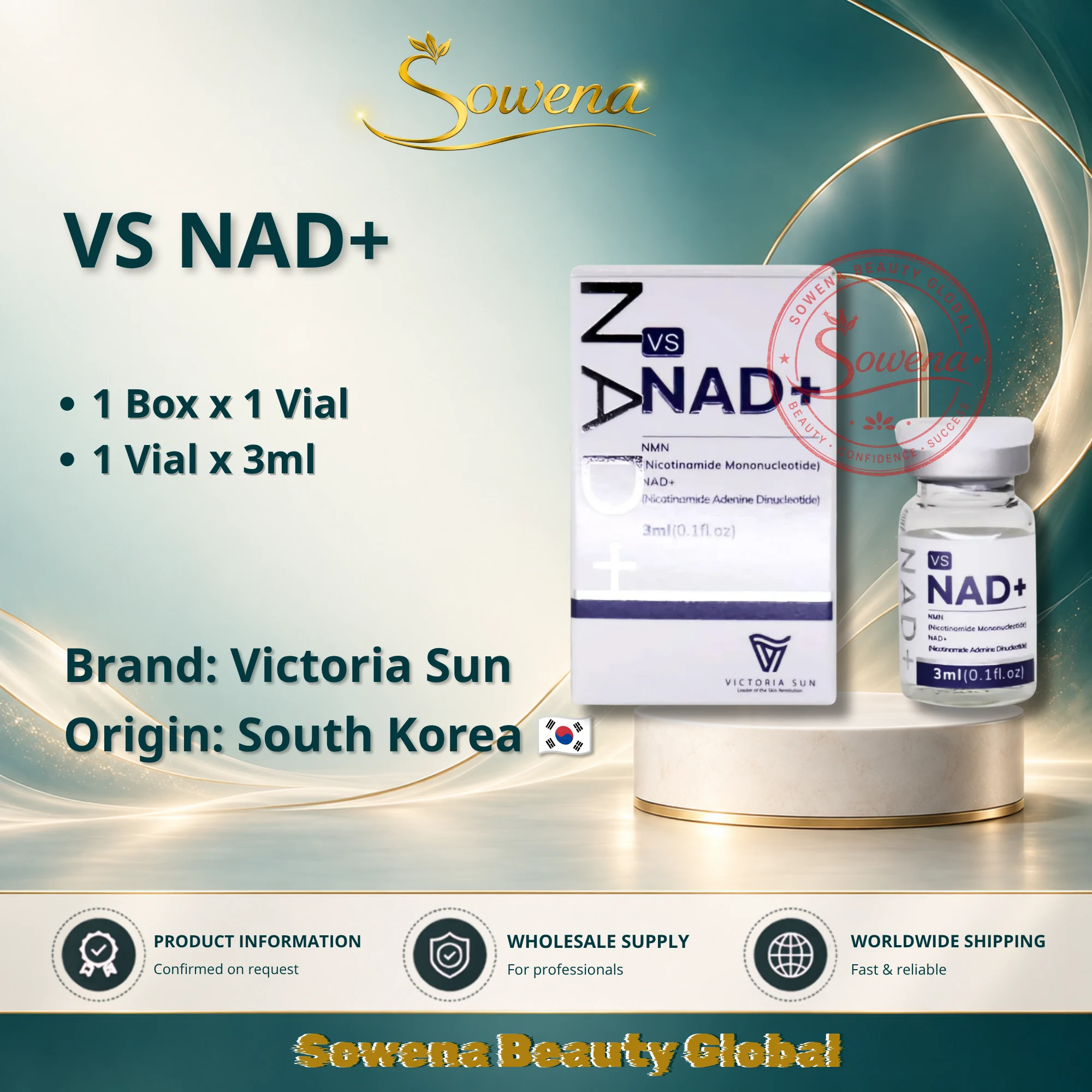
The approved Sowena product visual identifies VS NAD+ as a Victoria Sun product with South Korea shown as the country of origin. The artwork displays one box containing one 3 mL vial. The vial label visibly refers to NMN, short for nicotinamide mononucleotide, and NAD+. Victoria Sun also maintains an official page for the VS NAD+ product line.
These details are useful for initial identification, but a marketing image is not a complete technical specification. Packaging may be updated, and the image alone does not establish concentration, sterility, intended route, regulatory status or suitability in a destination country. Current batch documentation should take priority over a website description.
- Brand shown: Victoria Sun.
- Product shown: VS NAD+.
- Origin shown: South Korea.
- Pack format shown: one box with one 3 mL vial.
- Label references shown: NMN and NAD+.
Why NAD+ attracts professional interest
NAD+ is a naturally occurring coenzyme involved in cellular redox reactions and energy metabolism. Academic research also discusses its relationship with ageing biology, DNA-repair pathways and cellular stress. NMN is studied as a precursor that can contribute to NAD+ biosynthesis. This biological background explains why NAD+-related language now appears in wellness and aesthetic product conversations.
The important limitation is equally clear: a biological mechanism is not the same as proof that a specific commercial formula produces a particular cosmetic result. A critical review indexed by PubMed notes that many questions remain about translating NAD+ precursor research into human outcomes. Professional marketing should therefore avoid jumping from general laboratory findings to claims about VS NAD+ itself.
What VS NAD+ should be compared with
Buyers often compare NAD+-labelled products with conventional hyaluronic acid skin boosters. The categories should not be treated as automatically interchangeable. Hyaluronic acid products are commonly evaluated around hydration, rheology, concentration and crosslinking or non-crosslinking status. NAD+-themed formulas are more likely to be compared through their full ingredient documentation, precursor content, product positioning and supporting evidence.
VS NAD+ should also be distinguished from related Victoria Sun names such as VS Vitathione NAD+, VS PNAD+ and VS Collagen NAD+. Similar branding does not prove identical composition or intended use. Ask for a separate, current specification for each SKU and compare documents line by line.
A responsible professional-buyer checklist
Product selection should begin with documentation rather than a before-and- after promise. A credible supplier should be able to identify the exact SKU being offered and explain which documents can be supplied for that lot and destination market.
- Identity: confirm the full commercial name, packaging version, manufacturer or responsible company and country of origin.
- Composition: request the current ingredient list and product specification rather than inferring composition from the name.
- Batch evidence: confirm lot number, manufacturing or expiry markings and any available certificate linked to that batch.
- Storage: request the official storage range, light protection requirements and handling guidance before arranging shipment.
- Transport: ask how the supplier protects the product during international transit and how exceptions are documented.
- Market eligibility: verify import, sale, advertising and professional-use requirements with the relevant local authority.
Authenticity checks before a larger order
High-quality imagery is helpful for matching the expected visual identity, but it cannot establish authenticity on its own. Compare the physical box, vial and printed details with current official references. Look for consistent spelling, print quality, label placement, lot information and tamper evidence. Ask the supplier to show the actual stock when practical, not only a reusable catalogue image.
Keep the invoice, shipping documents and product photographs connected to the same order record. When a batch number or expiry date is unclear, resolve it before the product enters professional inventory. A small initial order can reduce exposure while a new supply relationship is being evaluated, but it does not replace legal or technical due diligence.
Storage and international shipping questions
Storage requirements must come from current product documentation. Do not assume that every skin booster follows the same temperature range. Before dispatch, establish who is responsible for packing, temperature protection, customs documentation, transit monitoring and handling a delayed shipment.
Professional buyers should also define acceptance criteria. Examples include intact outer packaging, readable lot and expiry information, no visible vial damage and delivery within the agreed logistics conditions. If the shipment falls outside an official condition, quarantine it and seek documented advice instead of making an informal judgement.
Compare quotations on more than unit price
A lower unit price can become expensive when documentation is incomplete, shipping conditions are unclear or the offered pack does not match the requested SKU. Compare quotations on a like-for-like basis: exact product name, units per box, vial volume, quantity, currency, shipping term, freight, lead time and document availability. State whether duties and local import costs are included so that internal purchasing teams can calculate a realistic landed cost.
Service quality also has practical value. Before approving a larger order, assess response time, clarity of answers, willingness to provide current stock evidence and the process for reporting damaged or non-conforming goods. A dependable professional relationship is built on traceable records and precise communication, not only an attractive catalogue image.
How clinics can communicate about the category
Responsible communication stays close to verifiable facts. A clinic can explain that NAD+ is a coenzyme studied in cellular metabolism and that VS NAD+ belongs to a professional aesthetic product category. It should not turn that context into guaranteed rejuvenation, disease-treatment language or an exact timeline for visible change without product-specific evidence.
Client-facing suitability and consent remain professional matters. Any professional-use product should be assessed by an appropriately qualified practitioner under the rules of the local market. This article intentionally excludes administration technique, dosage and treatment scheduling.
Verified sources and further reading
- Victoria Sun: VS NAD+ Official brand page confirming the VS NAD+ product line.
- PubMed: critical review of NAD+ precursors Independent scientific context and limitations; not product-specific evidence.
Sowena product and community links
Explore the Sowena product catalogue, review our brand and partnership approach, read the professional supplier evaluation guide, or use the contact page to request current product information.
- Instagram See Sowena product visuals and company updates.
- WhatsApp Request VS NAD+ documents and quotation guidance.
- Telegram community Join the Sowena professional beauty community.
Approved product visual
FAQ
What verified details are available for VS NAD+?
The approved packaging visual identifies VS NAD+ as a Victoria Sun product from South Korea and displays one 3 mL vial per box. The visible label references NMN and NAD+. Current specifications should still be verified against official batch documents before ordering.
Does general NAD+ research prove the results of VS NAD+?
No. Research about NAD+ biology or its precursors does not establish the safety, effectiveness or clinical outcomes of a specific commercial aesthetic product. Product-specific evidence is required.
What should a professional buyer request before purchasing VS NAD+?
Request current product specifications, ingredient documentation, lot and expiry evidence, storage and transport requirements, authenticity evidence, invoices and any documents required by the destination market.
How to use this guide
The title “VS NAD+ professional product guide for aesthetic businesses” sets a specific reader expectation: the page should explain what VS NAD+ professional product guide for aesthetic businesses is, place it in the professional guide category and help a buyer distinguish verified product information from broad promotional language. A useful reading begins with the exact item in front of you. Confirm the name, presentation, manufacturer or brand owner, country-specific label and the documents supplied with that unit. Similar names, refreshed boxes and regional versions can exist, so a photograph or reseller caption is not enough to establish identity. This page therefore treats the title as a research question rather than a promise. It connects the product name with practical beauty goals while keeping formulation, suitability and regulatory conclusions tied to current evidence.
For this article, the catalogue context identifies the subject as VS NAD+ professional product guide for aesthetic businesses, associated with VS NAD+ professional product guide for aesthetic businesses and the professional guide category. Those catalogue fields help organise the discussion, but they are not a substitute for the current label. Before relying on any claim, compare the physical package with the latest technical information and an official manufacturer or authorised regional source when one is available. Check spelling, lot information, expiry marking, storage statement, seals and presentation details. If one element conflicts with the documentation, pause the decision and ask for clarification. This verification-first step is relevant whether the reader is comparing a familiar product, a new packaging version or several products with similar marketing terms.
Product purpose, area and realistic appearance goals
The most relevant application context for this topic is facial skin and any additional area explicitly supported by the exact product documentation. That phrase is intentionally cautious because the exact area must match the current product documentation, local rules and an individual assessment. A category name cannot establish that every product in the group is suitable for every facial or body zone. Readers should separate broad goals such as hydration, smoother-looking texture, balanced contours or a refreshed appearance from product-specific indications. The useful question is not simply “Is VS NAD+ professional product guide for aesthetic businesses popular?” but “Does the documented purpose of this exact product match the visible concern, the area being considered and the level of professional oversight required?” This keeps the article connected to the title without turning general education into personal treatment advice.
Appearance goals also need a consistent observation method. Compare photographs taken in similar lighting, from the same angle and at a similar time of day. Note surface comfort, hydration, reflection, texture and the way makeup sits rather than relying on one dramatic image. Facial expression, camera distance, sleep, hydration and editing can change how skin or contours look. A responsible VS NAD+ professional product guide for aesthetic businesses review therefore describes modest, observable goals and acknowledges variation. It should never guarantee an outcome, imply that one product can correct every concern or present a before-and-after photograph as proof that the same change will occur for another person.
Ingredients and finished-formulation evidence
Ingredient names are useful only when they are connected to the finished product. A broad study about hyaluronic acid, polynucleotides, amino acids, peptides, collagen-related materials or another fashionable ingredient may explain a scientific concept, but it does not automatically prove the performance of VS NAD+ professional product guide for aesthetic businesses. Concentration, molecular characteristics, excipients, manufacturing, presentation and the intended category can change how a formulation should be interpreted. Ask whether the evidence describes the same finished product, the same area and a comparable population. When an ingredient or concentration cannot be verified from current documentation, the correct editorial choice is to state that gap rather than infer a specification from the product name.
Readers can use an evidence hierarchy. Start with the current product label and instructions, then look for official technical documents and relevant regulatory information. Product-specific human research is more informative than a study on a loosely related ingredient. Independent reviews and authoritative clinical guidance can help explain limitations, while social posts and sales captions are better treated as leads to verify, not final proof. This hierarchy makes the article more useful for VS NAD+ professional product guide for aesthetic businesses: it rewards specific documentation, exposes uncertainty and reduces the risk of repeating a claim simply because it appears on many reseller pages.
How the three images support the article
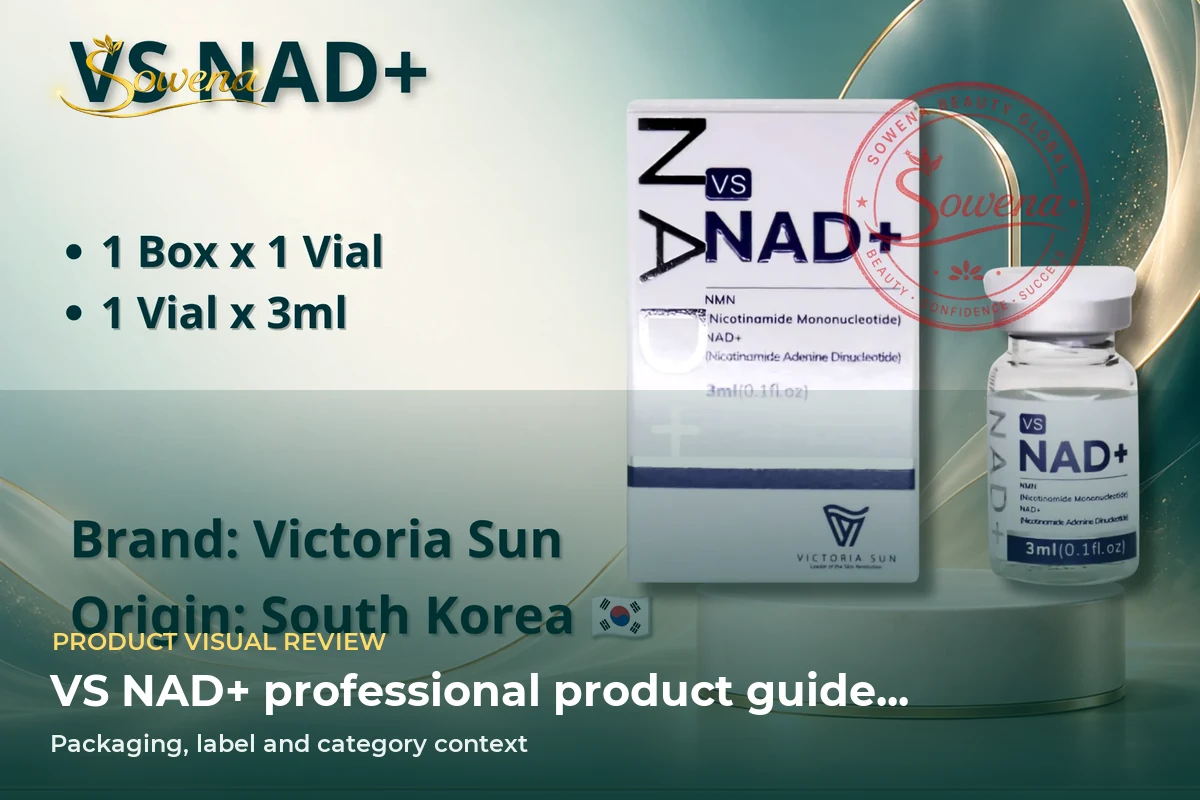
The first image identifies the article and its product or category context. The second image is a closer visual review derived from the approved Sowena source image, allowing readers to inspect presentation details without introducing an unrelated distributor watermark. The third image connects the topic with facial skin and any additional area explicitly supported by the exact product documentation. These images are educational aids, not authentication certificates. Packaging can change, generated editorial elements are not product evidence, and a photograph cannot confirm storage history or contents. Use the images to understand the article structure, then verify the physical unit and documentation independently.
Authenticity, storage and condition checks
A product can look correct in a photograph and still require further verification. Review seals, batch and expiry information, storage instructions, package condition and the consistency of the inner and outer presentation. Ask how the item was stored and transported when temperature or handling could affect quality. Keep invoices and product photographs linked to the same unit. If the package is damaged, information is missing, or the seller cannot explain the supply chain, do not treat a low price or familiar box design as reassurance. These checks are particularly important for professional-use products because appearance alone cannot establish sterility, authenticity or appropriate handling.
Country context matters as well. A product available in one market may have different status, labelling or professional restrictions in another. The catalogue origin listed for VS NAD+ professional product guide for aesthetic businesses can help a reader locate the relevant manufacturer information, but it does not establish approval everywhere. Check the regulator and professional rules that apply where the product would actually be used. Avoid unsupported phrases such as “globally approved” unless a current source defines the jurisdictions involved. Clear geographic language is more accurate and more useful for readers than a sweeping regulatory claim.
Routine support and sensitive-skin considerations
A stable daily routine creates a better baseline for evaluating beauty goals related to VS NAD+ professional product guide for aesthetic businesses. Gentle cleansing, a suitable moisturiser and consistent broad-spectrum sun protection support comfort and make visible changes easier to interpret. Introducing several strong topical actives at once can create dryness or redness that obscures the original concern. Readers with reactive skin should document fragrances, adhesives, topical anaesthetics, active ingredients and previous reactions. Patch testing may help with suitable topical cosmetics, but it does not determine whether a professional-use product or procedure is appropriate.
Persistent redness, pain, swelling, rash, infection, rapidly changing pigmentation or another concerning symptom needs qualified healthcare advice rather than product experimentation. A beauty article cannot diagnose the cause of a symptom. The useful role of this guide is to help readers prepare better questions: what concern is being assessed, what does the current label support, what alternatives exist, what would make a professional advise waiting, and how will progress or an adverse reaction be documented? This keeps the discussion reader-first and avoids presenting VS NAD+ professional product guide for aesthetic businesses as a universal solution.
Comparing VS NAD+ professional product guide for aesthetic businesses with related options
Compare products by purpose before comparing price. Two items may sit in the same professional guide category yet differ in presentation, verified composition, intended area, evidence and professional requirements. Create a short table with the exact product name, documented purpose, key verified ingredients, area, evidence type, storage needs and unresolved questions. Leave a field blank when information is unavailable. An honest blank is more valuable than an assumption. This method also prevents a common search mistake: choosing the product with the longest ingredient list or the strongest marketing adjective without checking whether it matches the reader's goal.
Alternatives should include simpler options. If the main concern is temporary dryness or barrier discomfort, a consistent topical routine may deserve attention before a professional product. If the concern is structural volume, pigmentation, active acne, scarring or another distinct issue, it may belong to a different product category or assessment. The title of this article remains useful when it helps the reader identify those boundaries. Good SEO content does not force every search toward the featured item; it gives enough context to recognise when VS NAD+ professional product guide for aesthetic businesses may not be the right comparison.
Questions for a qualified consultation
Bring the exact product name and clear photographs of the package to a consultation. Ask the professional to explain the product category, documented purpose, relevant area, expected limits, alternatives, reasons to postpone and the plan for recording concerns. Share allergies, medicines, previous procedures, pregnancy or breastfeeding status when relevant, active skin conditions and any history of unusual reactions. Do not request dosage or technique from a marketing article. Those decisions require training, current product information, local scope-of-practice rules and an individual assessment.
A strong final decision is easy to explain in one sentence: the documented purpose of this exact product matches the concern and area, the source and condition have been checked, the limitations are understood, and an appropriately qualified local professional has assessed suitability. If that sentence cannot yet be supported, the next step is more verification rather than a faster purchase. This standard applies to VS NAD+ professional product guide for aesthetic businesses and to every related product presented on Sowena.
Related Sowena reading
- Aqua PN: product facts, realistic goals and professional consultationRelated professional guide reading on Sowena.
- Aqualyx: product facts, realistic goals and professional consultationRelated professional guide reading on Sowena.
- Body contouring products: evidence, claims and evidence and safety checksRelated professional guide reading on Sowena.