
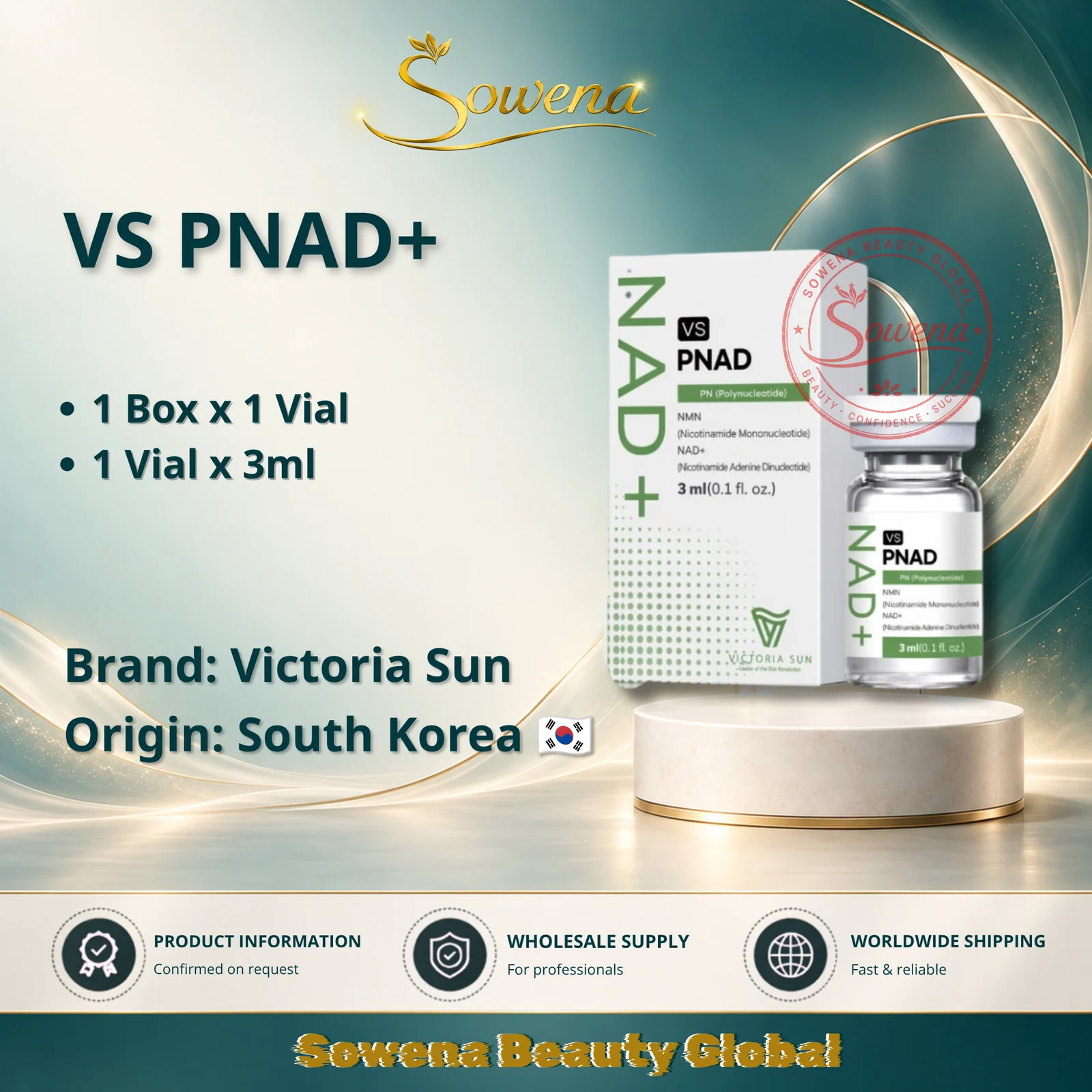
Interest in polynucleotide products has grown among people looking for smoother, fresher and better-hydrated-looking skin. VS PNAD+ combines several modern beauty terms on one package: PN, NMN and NAD+. Those names are interesting, but they do not tell the complete story of how a finished product performs. A useful evaluation starts with verified packaging details, realistic goals and an honest distinction between ingredient research and evidence for one specific product.
This guide is written for readers comparing skin-quality options before speaking with a practitioner. It does not provide injection technique, dosage, treatment schedules or a promise of results. VS PNAD+ is presented as a professional-use product, so suitability should be assessed by an appropriately qualified professional who can review the current label, documentation, skin history and local requirements.
What the approved VS PNAD+ image confirms
Sowena's approved product artwork shows a VS PNAD+ box and vial carrying the Victoria Sun name. The artwork states South Korea as the origin and shows one box containing one 3 ml vial. The visible package text names PN as polynucleotide, NMN as nicotinamide mononucleotide and NAD+ as nicotinamide adenine dinucleotide.
These are identification details, not a complete technical specification. The image does not establish ingredient concentrations, sterility documentation, intended administration, contraindications or approval status in every country. Packaging can also change. A professional should confirm the current batch, intact packaging, storage history, expiry information and manufacturer documentation before considering use.
- Product shown: VS PNAD+.
- Brand shown: Victoria Sun.
- Origin shown: South Korea.
- Pack shown: one 3 ml vial per box.
- Names visible: PN, NMN and NAD+.
What polynucleotides mean in aesthetic skincare
Polynucleotides, often shortened to PN, are chains built from nucleotides. In aesthetic medicine they are discussed as a skin-quality category rather than simply as products that add volume. Published reviews have explored their potential relationship with hydration, elasticity, texture and the appearance of fine lines. However, studies use different products, methods and outcome measures, and the overall evidence remains developing.
That boundary matters. Research on the PN category cannot automatically prove the effects of VS PNAD+. A product-specific decision needs product-specific documentation and a qualified assessment. The most responsible expectation is gradual support for the appearance of skin quality, not a guaranteed transformation or a claim that normal ageing can be reversed.
NMN and NAD+: related terms with different roles
NAD+ is a coenzyme involved in cellular energy metabolism. NMN is studied as a precursor used by the body in pathways connected with NAD+. This relationship explains why both names appear in longevity and beauty discussions. It does not mean that seeing NMN and NAD+ on a package proves a particular cosmetic result in human skin.
When comparing products, ask whether claims refer to basic laboratory science, research on an ingredient category or clinical evidence for the finished formulation. These are different levels of evidence. For more background on this distinction, read the VS NAD+ professional guide and the VS Vitathione NAD+ glow guide.
Realistic appearance goals for PN-focused products
Skin quality is broader than one wrinkle or one dark spot. A balanced evaluation considers hydration, surface smoothness, elasticity, comfort and how evenly the skin reflects light. These features can change with age, climate, sun exposure, sleep, stress, barrier damage and daily skincare. A professional product is only one part of that picture.
- Hydrated appearance: skin may look less crepey when its moisture balance and barrier are supported.
- Smoother-looking texture: realistic goals focus on refinement, not pore removal or perfectly smooth skin.
- Freshness and glow: even light reflection often depends on hydration and gentle surface care.
- Elastic-looking skin: changes should be assessed gradually and with consistent photography.
- Fine-line appearance: improvement is different from permanent wrinkle removal.
How to support skin quality every day
Daily habits create the foundation for any professional consultation. Use a gentle cleanser that does not leave the skin tight, follow with a moisturiser suited to the season and apply broad-spectrum sunscreen consistently. These simple steps help reduce avoidable dryness and sun-related unevenness, making it easier to judge whether an additional product is providing value.
Introduce topical actives one at a time. A retinoid may support texture and fine-line goals, while vitamin C is often selected for antioxidant and tone support. Exfoliating acids can help some people with surface roughness, but combining several strong actives can make the skin look redder and less healthy. The best routine is not the longest one; it is the routine the skin tolerates and the user can maintain.
VS PNAD+ compared with common skin-quality categories
Product categories answer different needs. Hyaluronic acid-focused products are commonly associated with hydration and, depending on the formulation, volume. PN products are discussed around regenerative and skin-quality goals. Topical retinoids support a long-term home routine, while moisturisers focus on barrier comfort. These options should not be treated as interchangeable simply because they all use words such as rejuvenation or glow.
If the main concern is dry, tight or flaky skin, repairing the daily barrier routine may be the most useful first step. If the concern is loss of volume or a structural facial change, a PN-focused product may not match the goal. When several concerns overlap, a practitioner can explain which category fits the desired outcome and whether doing less would be safer and more effective.
Considerations for sensitive or reactive skin
Sensitive skin benefits from a cautious, documented approach. Keep the home routine stable before a consultation so temporary irritation is not confused with the underlying concern. Tell the practitioner about previous reactions, allergies, active skin conditions, current medicines and recent procedures. Professional assessment is especially important around inflamed, infected or barrier-compromised skin.
For daily care, fragrance-free moisturiser, gentle cleansing and consistent sunscreen often provide more value than frequent product switching. Patch testing can help with suitable topical cosmetics, but it does not establish whether a professional-use product is appropriate. Persistent burning, swelling, rash or rapidly changing pigmentation warrants medical advice rather than another beauty product.
Questions to ask before choosing a professional product
A good consultation should be specific and unhurried. Ask to see the current sealed packaging and documentation rather than relying on a social-media image. Confirm who manufactured the product, how it was stored, whether the batch is traceable and what evidence supports the proposed goal. Ask what alternatives exist, what temporary effects may occur and what follow-up is available if the skin does not respond as expected.
- Is this exact product appropriate for my skin concern and history?
- What is confirmed in the current ingredient and technical documentation?
- How will progress be assessed without edited lighting or filters?
- What are the realistic limitations and alternatives?
- Who should I contact if I experience an unexpected reaction?
Research context and official-source status
Independent reviews indexed by PubMed describe growing interest in PN products while also noting variation in study quality, formulations and protocols. They support careful, evidence-aware discussion of the category, not claims that every PN product will produce the same result. A dedicated official VS PNAD+ product page could not be verified when this article was prepared. Victoria Sun's official company website is therefore included only as a brand reference.
- Victoria Sun official websiteOfficial company and professional portfolio reference.
- Polynucleotides in aesthetic medicine reviewIndependent review of current practices, potential outcomes and evidence limitations.
- Systematic review of polynucleotides in aesthetic medicineEvidence synthesis highlighting promising findings and the need for higher-quality research.
Continue exploring with Sowena
Browse the Sowena product catalogue, learn about Sowena Beauty Global, or use the contact page for guidance. These channels can help you compare product categories, while suitability for a professional procedure must remain with an appropriately qualified practitioner.
- InstagramSee Sowena product visuals and beauty updates.
- WhatsApp guidanceAsk in English about product categories and documentation.
- Telegram communityFollow community updates from Sowena Beauty.
Frequently asked questions
What ingredients are named on the VS PNAD+ packaging?
The approved visual names PN, NMN and NAD+. The complete current formula and concentrations should be confirmed from official documentation before a professional-use decision.
Is VS PNAD+ a daily skincare serum?
No. It is presented as a professional product and should not be treated as interchangeable with a topical serum or used without an appropriately qualified practitioner.
Can VS PNAD+ guarantee younger-looking skin?
No. Ingredient names and category research cannot guarantee product-specific results. Visible outcomes vary with the formulation, skin condition, professional assessment, aftercare and daily habits.